Gene Synthesis refers to the construction of gene-length DNA, typically 800bp to 3kb in length, at base-level precision.
Section divider: Gene Synthesis. The subtitle reads, building up gene-length DNAs from single bases.
Two ways to buy DNA, measured the same five ways, so read them across rather than down. This column is one oligo from IDT at the 25 nanomole scale. It is short, it is cheap by the base, and over ninety percent of these orders ship inside a day. What arrives is chemically pure, single-stranded, and non-clonal.
The two vendor specifications set as one comparison: the five measures down the left, a vendor to a column, values reading straight across. The first column is IDT single-sequence oligonucleotide synthesis at the 25 nanomole scale in 2026: size 15 to 60 bases, price 47 cents per base at US list, yield 10 nanomoles, turnaround with over 90 percent of orders shipping within 24 hours, and the DNA arrives chemically pure, sequence non-clonal and single-stranded. The second column is empty until a click. A source line under the table reads, vendor list prices, September 2026.
Oligonucleotide Synthesis
Phosphoramidite oligonucleotide synthesis
A 35-mer primer runs about $5, and it is in hand the next day
Over 60 bases the order moves up a scale, and the price per base roughly doubles
Past about 100 it is a different product altogether — several vendors sell one, all of them much more expensive
They are synthesized 3’ to 5’, opposite that of polymerases
Non-clonal: deletions and truncations increase towards the 5’ end
These are the numbers you will design against, so take the second line seriously. Nothing about a 61-mer is chemically harder than a 60-mer. It simply does not fit the smallest scale, so the whole order moves up a scale and the per-base price nearly doubles. Keep your oligos at 60 and under unless you have a reason not to, and when you genuinely need two hundred bases, know that you are buying a different product at a different price.
Five short lines on what phosphoramidite oligonucleotide synthesis costs and can do: a 35-mer primer runs about five dollars and arrives the next day; over 60 bases the order moves up a scale and the price per base roughly doubles; past about a hundred bases it is a different product altogether, sold by several vendors and much more expensive; the oligo is built 3-prime to 5-prime, opposite a polymerase; and it is non-clonal, with deletions and truncations increasing towards the 5-prime end.
Ligase Chain Assembly
Example: Gene synthesis oligo design
Construct the complete sequence to be synthesized, including restriction sites and 5’ tails
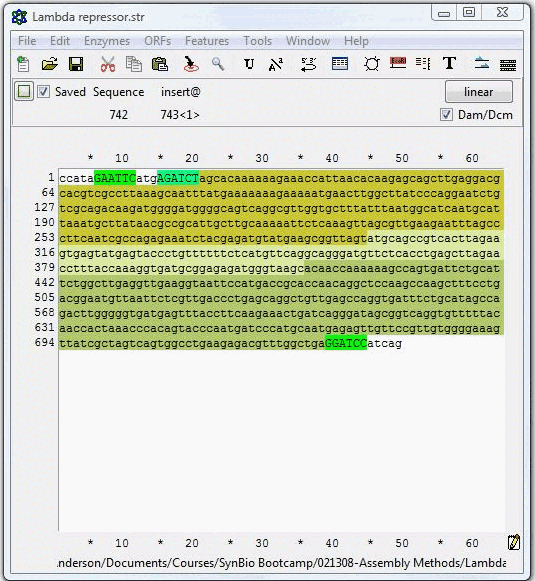
This is the design step, and all of it happens before you order anything. The window is a sequence editor with the part you want in it. What you paste in has to be the finished molecule, sites and tails and all, because the assembly builds exactly the sequence you hand it and anything you leave off here you simply will not have at the end. The button puts this exact cassette on your clipboard, all 742 bases of it, ready to paste into the calculator on the next slide. The file beside it is the annotated version, the one in the screenshot, if you would rather open it in a sequence editor first.
A screenshot of a sequence editor holding the lambda repressor sequence with its restriction sites highlighted, beside the two instructions that go with it: construct the complete sequence to be synthesized, including restriction sites and 5-prime tails, then copy it to the clipboard. Under them, a button that copies the 742-base lambda repressor cassette and a link that downloads the annotated sequence file.
Cut both strands, half an oligo out of step
nothing pasted yet
C6-Tools does this job too, inside the spreadsheet suite you get later in the course
This is the tool, and the picture above it is the algorithm. Paste a cassette in and all of it redraws. The blue row is the forward strand cut into fifty-base oligos from the left. The red row is the same molecule cut from the other side: fifty-base oligos from the right, starting twenty-five bases in. That offset is the entire design. Every junction in the blue row falls in the middle of a red oligo, and every junction in the red row falls in the middle of a blue one, so at every nick there is always a strand running across it holding the two neighbours together for the ligase to seal. The dashed lines are the blue junctions dropped through, so you can watch where each one lands. Nothing here is clever. It does not look at melting temperature, it does not avoid hairpins, it does not move a junction to a better place, and for a gene this size that is good enough. Watch the shortest overlap as you change the oligo length: the two strands are measured from opposite ends, so unless the molecule happens to be a whole number of oligos long the overlaps do not all come out the same. C6-Tools does this job too, in the spreadsheet suite you get later in the course, along with everything else.
A working calculator, with a map of the cut across the top. In the map the molecule is drawn twice, to scale: an upper row of blue blocks, the forward strand cut into fifty-base oligos from the left, and a lower row of red blocks, the same molecule cut into fifty-base oligos from the right starting twenty-five bases in, so the two rows of blocks are offset by half a block. Dashed lines drop from every junction in the upper row and land in the middle of a block in the lower row. Under the map, a box to paste the complete cassette into, a field for the oligo length set to 50, and a button that loads the lambda repressor; beside them the resulting order, forward oligos then reverse oligos, each named and numbered, with the base count, the oligo count and the shortest overlap above them and a button that copies the whole set. A line at the foot of the slide notes that C6-Tools does this job too, inside the spreadsheet suite given later in the course.
LCA example question
Design a set of oligos to synthesize the amilGFP gene as a BioBricks part using Ligase Chain Assembly
Give them a few minutes on this before you press the button. The work is the first step, not the second: take the open reading frame printed here and put the BioBrick ends on it, twenty-five bases at each side, because the assembly builds exactly the molecule you hand it. The cutting is arithmetic, and the calculator two slides back does it. The button shows the finished cassette with the tails picked out in blue and the counts underneath. The two buttons beside it put the cassette and the whole oligo list on your clipboard, so you can paste the cassette back into the calculator and watch the map redraw for this gene rather than for lambda.
A question for the room, marked with the deck's thinking figure: design a set of oligos to synthesize the amilGFP gene as a BioBricks part using Ligase Chain Assembly. The amilGFP open reading frame is printed below it, 696 bases in twelve lines.
PCA Assembly
(Polymerase chain assembly)
PCA Assembly
(Polymerase chain assembly)
Start with overlapping 50-60bp Oligos
Combine in a thermostable polymerase reaction
Run a PCR-like program
Use “assembly product” as template for a conventional PCR with external oligos
Clone the product into a vector to generate a synthon
Cut once, and let the oligos overlap
nothing pasted yet
C6-Tools, the same pca() function, in the spreadsheet suite you get later in the course
Same slide, different assembly, and the difference is the whole point of putting them side by side. LCA tiled both strands completely, so every base was ordered twice. PCA orders every base once. The oligos hop from strand to strand, each one overlapping its neighbour by about twenty bases, and the shaded columns are those overlaps. Everything between them is not ordered at all; the polymerase fills it in. That is why the oligo count roughly halves for the same gene, and it is also why PCA cares about the sequence in a way LCA does not: the overlap has to anneal, so the tool moves each junction a few bases to find a stretch with a decent G-C content that does not fold back on itself. You can see that in the readout, where the overlaps are not all the same length. This is C6's own pca function running in the page, so what you get here is what you get from the toolkit.
A working PCA calculator, with a map of the cut across the top. In the map the molecule is drawn as a single row of oligos that alternate between an upper blue band and a lower red band, each one overlapping its neighbour by roughly twenty bases, with the overlaps picked out as shaded vertical columns running through both bands. Under the map, a box to paste the complete cassette into and a button that loads the lambda repressor; beside them the resulting order, each oligo named and numbered, with the base count, the oligo count and the range of overlap lengths above them and a button that copies the whole set. A line at the foot of the slide notes that this is the same pca function C6-Tools provides in the spreadsheet suite given later in the course.
PCA example question
Design a set of oligos to synthesize the amilGFP gene as a BioBricks part using Polymerase Chain Assembly
The cassette is the same one they built for the LCA question, so the first step is already done and the only new work is handing it to a different tool. Press the button and compare the two answers: LCA wanted thirty-one oligos for this gene and PCA wants twenty-eight, but the PCA set covers each base once rather than twice, so it is about half the synthesis. The old answer on this slide came out of GeneDesign, which is a different program with a different junction rule; what you see now is C6's pca, the function in the calculator two slides back and in the toolkit they will use.
The same question run the other way, marked with the deck's thinking figure: design a set of oligos to synthesize the amilGFP gene as a BioBricks part using Polymerase Chain Assembly, with the amilGFP open reading frame printed below.
Why don’t we always do this?
In practice it’s slow (our designs took 6 months)
As a non-clonal fragment it only gets you to 3kb before you need to break into two steps, due to mutation rates; sequence-verified clonal genes go further (7kb at Twist, 15kb at Elegen, 50kb at Ansa)
Difficult to synthesize repetitive sequences, biased GC-content, secondary structure (promoters and terminators are problematic)
$$
Total number of bases for 2014’s 140L: 43517
Would cost about ~$6,000 for basic parts
Would cost ~$200,000 for all the composite parts
Twist Clonal Genes list price, September 2026
Today, it is still the case that gene synthesis is used somewhat sparingly along side more conventional fabrication methods. It’s main drawback is that it is slow, and it is also expensive. At the current price, it is impractical for even commercial users to not reuse previously-synthesized genes. When I teach my BioE 140L course at Berkeley, around 20 students each produce around 3 parts. In a typicall year, this amounts to around 40000 bases which for the basic parts alone would cost around $6K. If all the composite parts that got generated during a project were synthesized de novo without reuse, the costs would begin pushing $200K. Thus, this methodology has a long way to go before other methods of fabrication can be fully eliminated from the design-build-test cycle. However, combined with automated assembly methods that enable reuse of synthetic sequence, the price point for these procedures is already making non-standardized DNA fabrication a thing of the past.
The limits of gene synthesis. Three objections first, as a list: it is slow, six months for our designs; as a non-clonal fragment it reaches only 3 kilobases before the work has to be split in two because of mutation rates, while sequence-verified clonal genes go further, to 7 kilobases at Twist, 15 at Elegen and 50 at Ansa; and repetitive sequence, biased GC content and secondary structure are all hard, which makes promoters and terminators the problem cases. Then cost, under a heading of two dollar signs: the total number of bases for the 2014 course was 43517, which would cost about 6,000 dollars for basic parts. That figure is drawn as a short bar. A source line at the foot of the slide reads, Twist Clonal Genes list price, September 2026.