att Integrases

Employing site-specific integrases from various phages to insert a DNA at a single locus of the genome

Phage att sites: in, and back out

The same site, at base resolution

Sequences from Genome Editing Examples.zip

There is more than one of these

φ80 is the one in your example files

J Bacteriol. 2001 Nov;183(21):6384-93   PMID: 11591683

CRIM att φ80 integration

J Bacteriol. 2001 Nov;183(21):6384-93   PMID: 11591683

Flp/FRT marker excision

Markerless integration

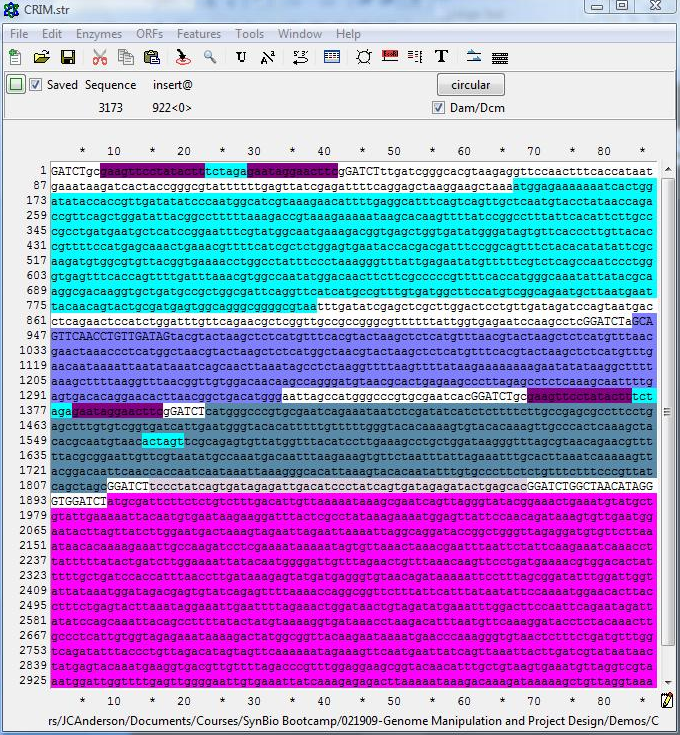
Φ80 CRIM plasmid

A circular map of the 3173 bp CRIM plasmid, with its features marked: the gene, CmR, the R6K origin, an FRT site, the phi80 att site, and the homology region used for recombination.
CRIM.seq  —  in the Genome Editing Examples zip

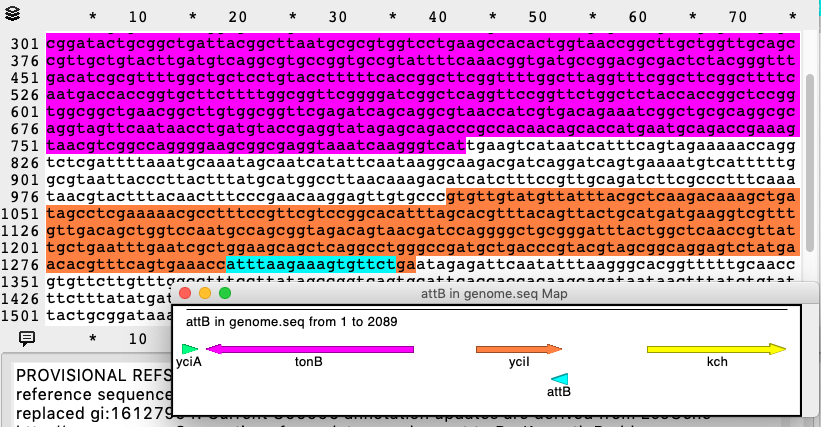
attB site in the E. coli genome

A sequence editor window showing the region of the E. coli genome that carries the phi80 attB site, with the recombination sequence highlighted.

Recombination and integration

The genomic attB sequence in a sequence editor, with the seventeen-base recombination sequence highlighted.
Genomic attB
The CRIM plasmid's attP sequence, with the same seventeen bases highlighted.
CRIM attP
The five-prime end of the integrated sequence, with the recombination sequence appearing at both ends of the inserted CRIM.
Genomic CRIM after integration.seq  —  the 5’ end of the integration

And after Flp

ycjI Phi80-attL R0040 gene (BamHI methyltransferase) FRT Phi80-attR ycjI kch genome genome (other half) everything between the att sites arrived on the CRIM and what is not here any more: CmR, and the R6K origin

Genomic CRIM after flp.seq  ·  drawn schematically, not to scale

No pUC for CRIM

Why can’t you use a normal pUC plasmid for doing CRIM integration?

Because it would replicate — so every transformant keeps the marker whether or not it integrated, and there is nothing to select.