Now getting the plasmid back out of the cells you grew. Two halves: break the cells open in a way that leaves the plasmid intact, then pull it out of everything else.
Section divider: Miniprepping.
The kit is buffers and columns, and the buffers have names that tell you nothing. So here is what is in them and why, because two of these steps are the whole method and the rest is washing.
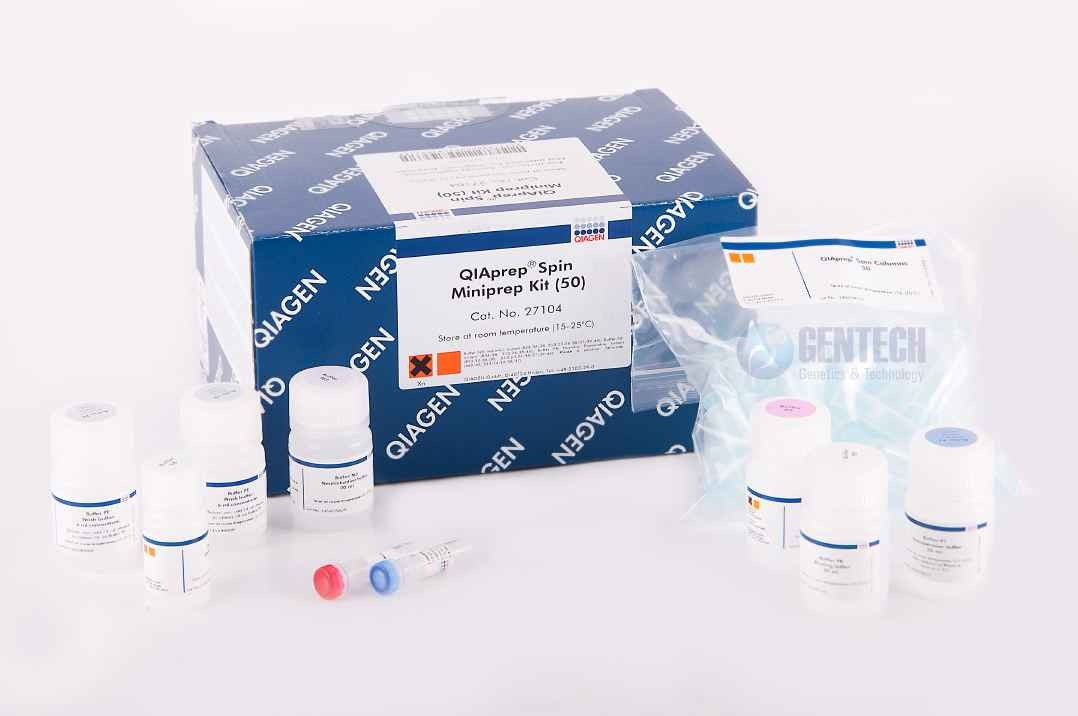
A photograph of a Qiagen miniprep kit: the box, the buffer bottles and the spin columns.
Why this works at all
Before the volumes, the reason. The chromosome and the plasmid are both double-stranded and both covalently closed circles, and the method turns on what happens to each of them when you denature it. The plasmid is small enough that its two strands stay wound round each other with nowhere to go. The chromosome is fifteen hundred times longer, its strands drift apart, and on neutralising they cannot find each other again. Length is what makes that true, but the thing being exploited is the topology.
A cell drawn as a rounded box, with one long wandering line for the chromosome and six small circles for the plasmid.
Alkaline lysis
The recipe is on the slide the whole way through, with the step you are on picked out. Watch the blue: it starts inside the cells and ends up in the supernatant, and every step is just moving it.
The alkaline lysis half of a miniprep, run in a tube beside the six-step protocol, with the current step picked out in red and the plasmid drawn in blue at every stage.
Column cleanup
The second half is a silica column and three washes. The DNA binds in chaotropic salt, the protein comes off in one wash, the salt comes off in the next, and the dry spin gets rid of the ethanol that would otherwise ruin your sequencing read.
The column half of a miniprep, run rather than listed: the lysate loaded, the DNA bound to the frit, three washes squirted in and spun through, a dry spin, the waste tube exchanged for a clean one, and the plasmid eluted into it.