Zymo Cleanup
Bench cheatsheet
Zymo Cleanup — the one-page version of this protocol. It is the same as the printed copies at the bench.
After confirming your PCR reaction on a gel, the next step is to purify the DNA. This is essential for most cloning workflows, especially Golden Gate and restriction enzyme-based cloning. Although it is optional for Gibson, cleanup helps remove components from the PCR that may interfere with downstream steps.
Why Cleanup Is Necessary
PCR reactions contain:
- Unreacted dNTPs
- Active polymerase
- Buffers and salts
These can interfere with cloning enzymes, particularly enzymes like BsaI that generate sticky ends. Polymerase can fill in sticky overhangs, preventing proper ligation. Cleanup eliminates these components.
How It Works
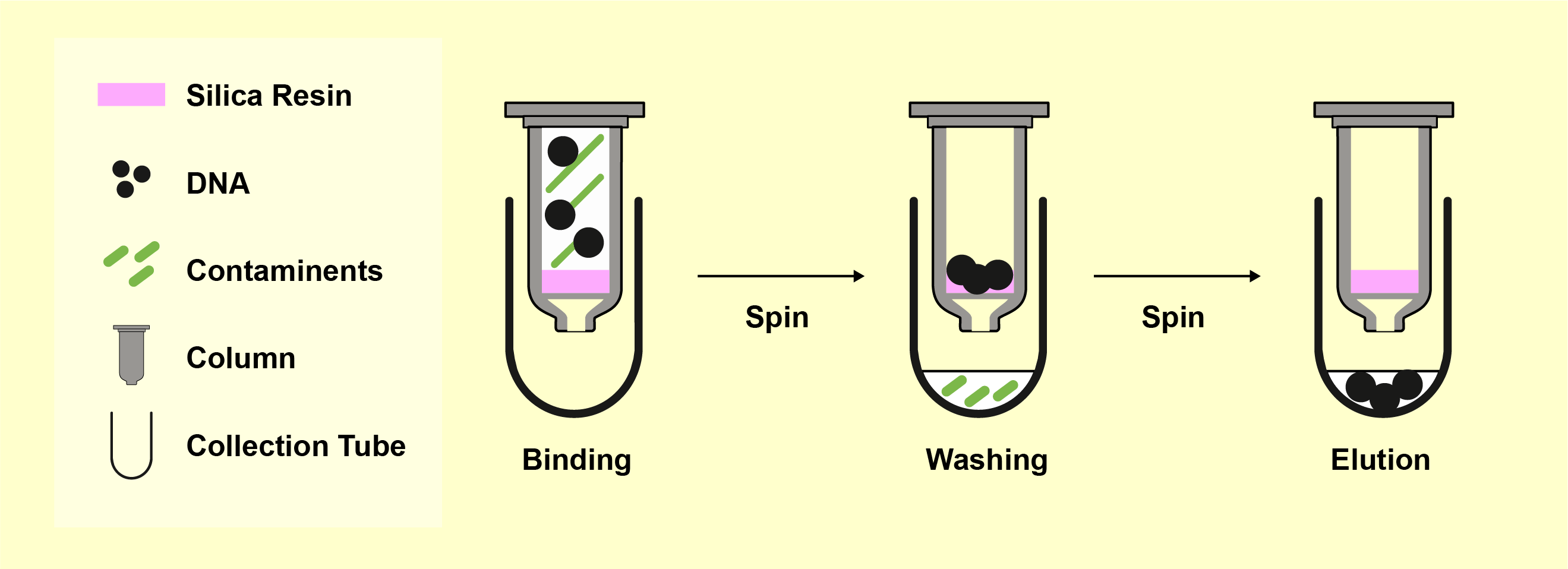
Figure: Stepwise diagram of silica column cleanup showing binding, washing, and elution. DNA binds to the pink resin in the column, contaminants are washed away, and purified DNA is eluted into a clean tube.
DNA binds to silica in the presence of a chaotropic salt—usually guanidinium thiocyanate—found in Zymo's ADB buffer. This same chemical also denatures proteins like polymerases.
The basic workflow:
- Mix PCR product with ADB buffer
- Pass through a silica column by centrifugation
- Wash the column with 70% ethanol (provided as PE or Wash buffer)
- Dry the column by spinning
- Elute DNA with water or EB Buffer
EB is preferred because it's a dilute Tris buffer. Pure water can absorb CO₂ and become slightly acidic, which may reduce recovery of DNA.
Be mindful: know where your DNA is at each step. Many errors involve discarding the DNA by accident.
Zymo vs. Other Kits
We use the Zymo DNA Clean & Concentrator-5 kit because it allows elution in as little as 6 µL, which is sometimes useful for concentrating the DNA. However, there are many equivalent products on the market.
Popular Alternative: Qiagen QIAquick Gel Extraction Kit (purple column)
- Typically used to extract DNA from excised gel slices
- Requires special buffer if binding from a gel
- Similar silica-based chemistry
Small fragments (under ~300 bp) need a different protocol. Bound in ADB alone, a small fragment does not stick to the column and goes out with the flow-through. Use Zymo cleanup of a small PCR fragment, which binds in ADB + isopropanol.
Lab Sheet Overview
Title: TPcon6-P6: Zymo
Location of PCR product: Enzyme freezer, PCR rack labeled “to Zymo”
| Reaction | Tube Label | Side Label | Elution Volume | Destination |
|---|---|---|---|---|
| 79 | z79 | P6 z79 | 25 µL | zymos1/___ |
Each PCR reaction you process will yield a new labeled Eppendorf tube with your cleaned-up DNA.
Step-by-Step: Regular Zymo Cleanup
This protocol removes polymerase, dNTPs, salts, and oligos from your PCR. It also works for cleaning up restriction digests.
- Side-label one Zymo column per sample with an ethanol-resistant pen — not a Sharpie, which the washes take straight off. Put each column in a collection tube in a rack.
- Pipette 180 µL of Zymo ADB buffer (brown bottle) into the column.
- Transfer all ~50 µL of the reaction into the ADB in the column, and pipette up and down to mix.
- Alternatively, premix the ADB and the sample in an Eppendorf tube, vortex, spin, then transfer to the column. Several routes work; what matters is that the solutions end up well mixed and in the column.
- Spin at full speed for 15 seconds, discard the flow-through.
- Add 200 µL of PE Buffer. Spin 15 seconds, discard the flow-through.
- Add another 200 µL of PE Buffer. Spin 15 seconds, discard the flow-through.
- Spin at full speed for 90 seconds to dry the column. PE is 70% ethanol and any carryover inhibits downstream enzymes.
- While the drying spin runs, clean up. Check the bench for drips of salt or ADB solution, and use 70% ethanol if you suspect any.
- Top- and side-label new 1.5 mL Eppendorf tubes, one per column, as indicated on your lab sheet.
- Insert the dry column into its elution tube.
- Add the elution volume (see lab sheet) of EB Buffer or water directly to the centre of the column matrix. Avoid letting liquid stick to the walls.
- Spin at full speed for 45 seconds to collect your purified DNA, then discard the column.
Why the elution tubes are labelled at step 9 and not at the start. An empty, labelled 1.5 mL tube sitting in the rack during the ADB transfers is exactly where the ADB ends up.
🧪 Quiz: Zymo Cleanup
Answer all questions correctly to pass. If you miss any, the quiz resets with a new randomized set.